
Imaan.Net - have faith
Homeschool

Living Books @ The Lightbulb Lab – 1

October 20, 2011 by Imaan 4 Comments

My kids and I have a humble little library that we open up to our fellow homeschoolers and bibliophiles. When I say “humble”, I really mean HUMBLE :) Many of our books are pre-loved – we buy in bulk from the second-hand bookstores – so they have seen better days. We’ve practically run out of shelf space so many of the books are stored in boxes. Our library ceiling until recently had paint and plaster flaking off in large chunks due to leaks on the roof. It has undergone serious repairs over the last week so it now, with primer and waterproofing material pasted on to the affected bits, looks like the body of a spotted cow.

I used to feel a little awkward about inviting people and kids up to the library because compared to most of the homes I’ve seen which are neat and beautifully decorated, our library looks untidy on good days and downright chaotic on the worst! I was heartened though when Aymun, one of my friends’ kids, said with utter sincerity and disarming charm that she liked our home very much because “it has all the nice books”. Since then, I’ve felt less self-conscious about our library, which we affectionately call The Lightbulb Lab … because it’s where bright ideas are born! (*grin* Guess which book this came from?)

Anyway! We went book shopping in Singapore and are awaiting the arrival of our purchases. Isloo Lighbulb Lab friends, you can look forward to these good reads soon in shaa Allah!

I’d written a review of Marita Conlon-McKenna’s beautiful if heart wrenching series about the Great Famine in an earlier post. I found the Children of the Famine trilogy wonderful living books. We lost our old copies during our numerous moves so I decided to purchase a set for the Lightbulb Lab. We learnt a great deal about the Irish and their way of life and we came to understand more about the country’s history/politics and its hostile relationship with the English. We also learnt about the life of the migrants in America as a result of the mass exodus.

If we seem to have read a lot about the Irish famine, it is because we have! The famine of 1845 was truly a turning point in Irish history. It saw the population of Ireland drop by some twenty-five percent – one million died of starvation or disease and another million emigrated. I read elsewhere that the famine contributed to the decline in the use of Gaelic. West Ireland, where Gaelic was at its strongest, was also the hardest hit in terms of deaths and emigration.

Anyway, another book we read in Singapore was Nory Ryan’s Song. Nory is a 12-year-old girl whose father has left to go fishing in a bid to earn more money to pay back taxes. All around her, neighbours are being evicted by the hard-hearted Lord Cunningham. When the blight hits Ireland, their simple life becomes a nightmarish struggle. They literally stare death in the face as they run out of food and begin to slaughter the few livestock they have. Brave Nory risks her life to get food for her loved ones and it is heartbreaking to read of her attempts to distract her little brother from his hunger. I won’t give away the rest of the story but needless to say, the girls and I were hooked and completed it in 2 days. We are looking forward to reading the sequel, Maggie’s Door, when Nory and her friend Sean journey to America to find their families. They lose one another amidst the chaos and their stories are told separately.
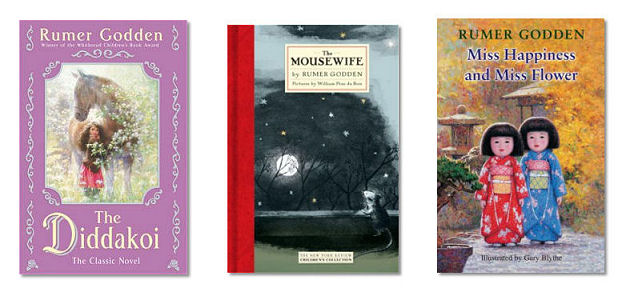
My children and I fell in love with Rumer Godden’s books and decided to buy copies of our own. Many of her books are out of print (or out of stock!) and that disappointed us to no end but we did manage to order 3 of them. The Diddakoi (Winner of the Whibread Children’s Book Award) is about Kizzy, a half-Romani (or gypsy as some would say) girl. When her only caregiver, her great-great-grandmother dies, she is unwanted by her relatives. She is taken in first by Admiral Twiss (on whose land she and her great-great-grandmother had lived on) and later fostered by Ms Brooke. Made to attend school, she is marginalised and bullied. Kizzy learns to cope and still retain her identity and her peers too learn to overcome their prejudices. A disturbing story but the happy ending makes it all worth it :) BBC made a TV series entitled Kizzy in 1976 – I don’t think it is available on DVD or anything… pity!

The Mousewife is an exquisite gem. This lyrical fable tells of a mousewife who dutifully cares for her family but yearns for something more in her life. Her husband does not understand her but when a turtledove is brought by the owner of the house in a cage, she finds a kindred spirit. The dove tells the mouse about the wondrous world beyond the walls – like how “the dew it shines on the leaves and grass in the early morning for doves to drink”; how the wind blows in the cornfields and the patterns it makes in the corn and so much more that the mouse can only imagine. Moved by the tales and knowing only too well how painful captivity is, she sets the regal bird free while she continues to dream. This isn’t just a child’s story as you can tell :)

Another vintage read is Miss Happiness and Miss Flower. Eight-year-old Nona is sent to live with her relatives in England and is homesick for her home in India. When a grandaunt in America sends two Japanese dolls as gifts, she identifies with them immediately – for are they not displaced in a foreign culture and place like her? She sets about building them an authentic Japanese home, complete with screen doors, tatami mats, niches for scrolls, garden and silk quilts. Quiet Nona grows in confidence as she enlists the help of her cousins, friends and even the crotchety bookstore owner. However, she still has a jealous cousin Belinda to contend with… My girls loved this story to bits and it revived their love for their little kokeshi dolls :) There is a sequel entitled Little Plum which is also a wonderful read – however, it is out of print and existing copies are ridiculously pricey!

I do have more books to review and recommend but it has been a long and trying day so I’ll save the rest for another post.

Share:
Reading time: 5 min
Homeschool Charlotte Mason Good Reads

Chapter Books We Like, Part 2

December 2, 2006 by Imaan 2 Comments

1. The Nine Lives of Montezuma by Michael Morpurgo
This chronicles the life of Montezuma, a ginger tom with a white patch on his throat. He has to fight for his life from the outset – as a newborn, he survives despite attacks from a barn owl, the attempts of a farmer to drown his siblings and abandonment from his neglectful mother. He is rescued by the farmer’s son, Matthew, and becomes a permanent and much-loved fixture in the household.

What follows are the many brushes Monty has with death. First, he gets his head stuck in a tin before hurling up a tree and falling in a pond. Then, he becomes involved in a violent fight with the farm dog, Sam, over Sunday roast left-overs. Next, he is stranded in a snowdrift and a brutal fight with a rival tom. He watches over Matthew who grows up and takes over the farm. But all creatures must face death and Montezuma dies, leaving behind fond memories…

2. Under the Hawthorne Tree by Marita Conlon-McKenna
I discovered this gem quite by accident and almost gave it a miss. I bought it for a mere 50 rupees (SG$1!!). This award-winning novel deals with the the Great Irish Famine that ravaged Ireland in the 1840s. The story centres around the O’Driscolls, the average Irish family who are tenant farmers, dependent on potatoes as their main source of food. Tragedy strikes in the form of “the Blight” – a disease that destroys the potato crops – and what ensues is extensive starvation.

Eily (who is 12), Michael (10) and Peggy (7) O’Driscoll have coped with heartbreak upon heartbreak. Their parents left to find work but have gone missing and their baby sister Bridget is dead and buried under the hawthorne tree. Their village is devastated and farmers are being evicted by the landowners. Surrounded by disaster and the threat of being sent to the workhouse, the children are determined to survive and stay together.

Armed with nothing but courage and love, they embark on a perilous journey across Ireland to find their great-aunts, Nano and Lena, whom they have only heard about in their mother’s stories. The children sleep in the open and forage for food in the wild and in the farms of dead tenants. They are confronted with death at every turn. They see bodies of those who died with no one to mourn or pray over them and they see the living dead – those so traumatised that they are but shells of their former selves.

When the O’Driscoll children arrive in Ballycarbery, they see the ships loaded with food bound for England. It is a painful and bitter pill to swallow – the landlords were making money while their countrymen were falling dead from starvation. And indeed, that is the irony of those horrific years – it was only the potato crop that failed; wheat, oats and meat were in excellent supply but they were shipped out to England. It is said that a million and a half people died during these dark years and another million emigrated.

Read about how Eily, Michael and Peggy push every fibre of their being to stay alive and find a better home. This book is part of a trilogy – the other books in the series are Wildflower Girl and Fields of Home. I haven’t read these, but if you have tell me about them! The book has also been made into a film and study guides are available at O’Brien Press.

Update: We found Wildflower Girl in a little bookshop in Islamabad! It is good… review later in shaa Allah…

3. The Akimbo books by Alexander McCall-Smith
Alexander McCall Smith was born in Zimbabwe was educated there and in Scotland. A Professor of Medical Law at the University of Edinburgh, he is a best-selling author of adults’ books but proves that he is equally adept with younger audiences. I was told about his books by a fellow homeschooler who adores books. We went on a hunt and were rewarded with a box set that was in perfect condition!

The set features Akimbo and the Elephants, Akimbo and the Lions and Akimbo and the Crocodile Man. (There is another book out there Akimbo and the Snakes that we have not read, so if you see it, give me a shout OK?)*

Akimbo is a young, adventurous African boy who lives in a large game reserve where his father is a head ranger. He is passionate about animal conservation and goes through great lengths to protect them. In Akimbo and the Elephants, Akimbo helps to bring down an elephant poaching ring. In Akimbo and the Lions, he helps to raise a lion cub and becomes attached to it. However he knows that Simba belongs in the wild. It is a heartbreaking moment when he releases Simba. (Oh how Ms M cried!) In Akimbo and the Crocodile Man, our resourceful friend is given the chance to accompany John the Crocodile man who is doing research on a batch of crocodiles. During a trip, John is attacked by an angry croc. It is a race against time as Akimbo braves dangerous waters to get help for his friend. Ms M loved the bit where Akimbo hotwires a truck, drives it and barely misses crashing into a tree!

I loved this series just as much as Ms M did. The descriptions are simple and yet incredibly detailed and will transport you to the beautiful African continent. We finished each book in one sitting and liked the charming black and white illustrations by Peter Bailey. I’d recommend this for both boys and girls who are getting into chapter books.

* Update: We have read Akimbo and the Snakes – nice stuff!

OK more in Part 3 – kids are hankering for breakfast!

Share:
Reading time: 4 min

Search

About

  • Just a bunch of crazies
  • The Head Crazy
  • Send a Message

Archives

  • Islam
  • Homeschool
  • Charlotte Mason
  • Craftiness
  • Good Reads
  • Good Food
  • Journaling
  • Marzipan
  • Bear
  • Peep
  • The Stuff of Life
  • The Chai Files – Pakistan
  • The Rice Files – Singapore
  • Whatever

© 2020 copyright imaan.net // All rights reserved
Designed by Premiumcoding